
The Free Cash Flow is the net amount of cash generated by the company, and available to repay debt, pay dividends to investors or expand the business. So, in other words, it is the remaining cash after deducting operational expenses, taxes, interest paid, and purchases of PP&E (CAPEX).
Table of Contents
Formula

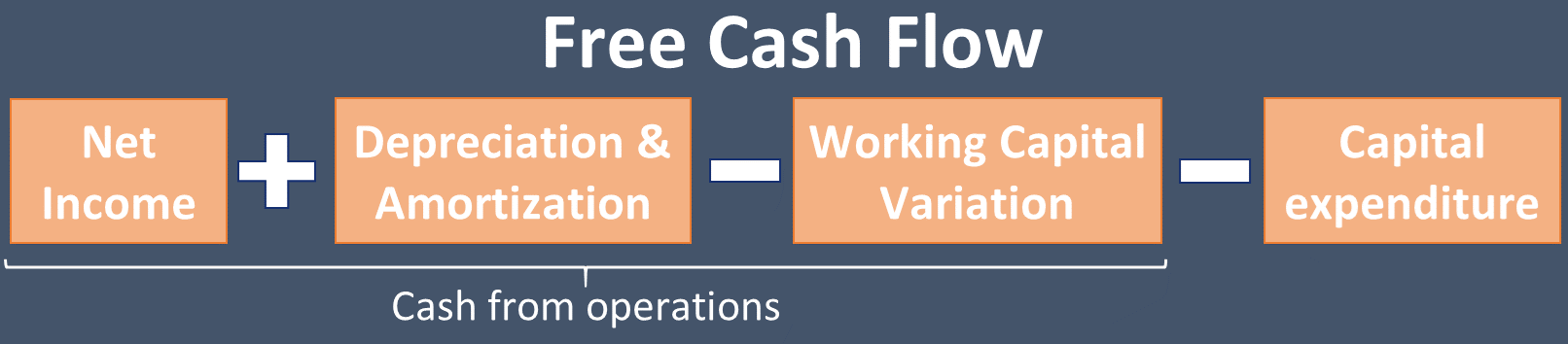
If cash from operations is broken down, the formula is as follows:
Example
In this link, you can download a comprehensive example of the Free Cash Flow (FCF) calculation. The document includes templates and formulas for FCF, Profit & Loss statement (P&L) and Balance Sheet.

Explanation
- Net income: can be obtained from the Profit & Loss statement. By including net income in the calculation, all business revenues and expenses for a specific period are incorporated. Alternatively, you may begin the calculation using EBITDA (see below).
- (+) Depreciation and amortization: actually, we have to add not only the depreciation and amortization amounts, but also all non-cash expenses. Depreciation and amortization are the most common non-cash expenses, but any others should be considered as well. By adding non-cash expenses, we adjust the net income to account for all P&L expenses that did not result in cash outflows.
- (-) Working Capital variation: typically, Working Capital is calculated as the difference between current assets and current liabilities. However, for our purpose, working capital will be calculated as: Stock + Account Receivable (trade and others) – Account Payable (trade and others). Items such as short-term financial liabilities or cash are excluded. Including Working Capital variation in the formula adjusts the net income to account for the timing differences between payments/collections and revenues/costs.
- (-) Purchases of PP&E (CAPEX). Since this cash outflow is not part of any of the mentioned measures above, it must be deducted.
Using EBITDA in FCF calculation
Alternatively, we can calculate FCF from EBITDA instead of using net income:

Unlike net income, EBITDA already excludes depreciation and amortization, so this non-cash adjustment is no longer necessary. However, interest and tax payments must be deduced. Moreover, Working Capital variations and CAPEX Cash out must still be considered.